

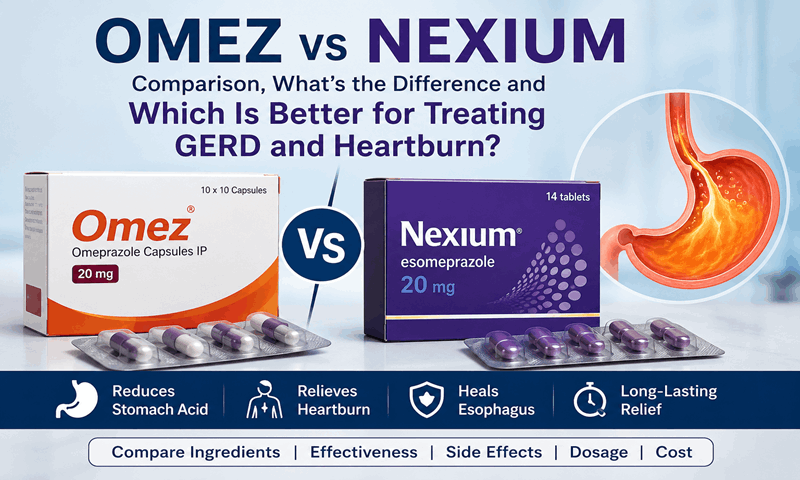
- What Is Omez?
- What Is Nexium?
- Omez vs Nexium: Quick Comparison
- Active Ingredient Difference
- Which Works Faster?
- Which Is More Effective for GERD?
- Omez vs Nexium Side Effects
- Dosage Comparison
- Drug Interactions
- Which One Is Better?
- Can You Switch Between Omez and Nexium?
- Lifestyle Tips to Improve GERD
- Frequently Asked Questions
- Final Verdict
Heartburn and gastroesophageal reflux disease (GERD) affect millions of people worldwide, causing symptoms such as burning chest pain, acid regurgitation, bloating, and difficulty swallowing. Two commonly prescribed medications for these conditions are Omez and Nexium. While both reduce stomach acid and belong to the same class of drugs, they differ in their active ingredients, potency, duration of action, and cost.
If you’re wondering “Omez vs Nexium – which is better?”, this comprehensive comparison will help you understand their similarities, differences, benefits, side effects, and which medication may be the right choice for your condition.
What Is Omez?
Omez is a proton pump inhibitor (PPI) that contains Omeprazole as its active ingredient. It works by blocking the proton pumps in the stomach lining, significantly reducing acid production.
Doctors commonly prescribe Omez to treat:
- Gastroesophageal reflux disease (GERD)
- Frequent heartburn
- Gastric ulcers
- Duodenal ulcers
- Zollinger-Ellison syndrome
- Erosive esophagitis
- H. pylori infection (in combination with antibiotics)
Relief usually begins within a few days, although some patients notice improvement after the first dose.
What Is Nexium?
Nexium contains Esomeprazole, the S-isomer of omeprazole. It is also a proton pump inhibitor but was developed to provide more consistent acid suppression in some patients.
Nexium is prescribed for:
- GERD
- Chronic acid reflux
- Erosive esophagitis
- Healing stomach ulcers
- Prevention of NSAID-induced ulcers
- Zollinger-Ellison syndrome
Many physicians prefer Nexium for patients with severe GERD or those who do not respond adequately to omeprazole.
Omez vs Nexium: Quick Comparison
| Feature | Omez | Nexium |
|---|---|---|
| Active ingredient | Omeprazole | Esomeprazole |
| Drug class | Proton Pump Inhibitor | Proton Pump Inhibitor |
| Primary use | GERD, ulcers, heartburn | GERD, ulcers, severe acid reflux |
| Acid suppression | Effective | Often slightly stronger and more consistent |
| Duration | Up to 24 hours | Up to 24 hours |
| Typical dosing | Once daily | Once daily |
| Generic availability | Yes | Yes |
| Cost | Usually lower | Usually higher |
Active Ingredient Difference
The biggest difference lies in the active ingredient.
Omez contains Omeprazole, which consists of two mirror-image forms (R and S isomers).
Nexium contains only Esomeprazole, the S-isomer, which may stay in the bloodstream longer and provide more consistent acid control in some individuals.
For many patients, however, the difference in symptom relief is relatively small.
Which Works Faster?
Both medications generally begin reducing stomach acid within 1–4 hours, but they are not intended for immediate heartburn relief.
Maximum effectiveness is usually achieved after 2–4 consecutive days of daily use.
Neither medication should be used as a fast-acting antacid.
Which Is More Effective for GERD?
Clinical studies suggest that Nexium may provide:
- Better healing of erosive esophagitis
- Slightly stronger acid suppression
- Improved symptom control in severe GERD
However, Omez remains highly effective for:
- Mild to moderate GERD
- Occasional acid reflux
- Peptic ulcer disease
- Long-term acid suppression in many patients
For most individuals with uncomplicated GERD, both medications work well when taken correctly.
Omez vs Nexium Side Effects
Both medications have similar side effects because they belong to the same drug class.
Common side effects include:
- Headache
- Nausea
- Abdominal pain
- Diarrhea
- Constipation
- Gas
- Dizziness
Rare but serious side effects include:
- Kidney problems
- Low magnesium levels
- Vitamin B12 deficiency with long-term use
- Increased risk of bone fractures after prolonged treatment
- Clostridioides difficile-associated diarrhea
Always seek medical attention if you experience severe allergic reactions, persistent diarrhea, or unusual symptoms.
Dosage Comparison
Omez
Common adult doses include:
- 20 mg once daily
- 40 mg once daily (for severe conditions)
Nexium
Common adult doses include:
- 20 mg once daily
- 40 mg once daily for erosive esophagitis or severe GERD
Both medications should generally be taken 30–60 minutes before breakfast for the best results.
Drug Interactions
Both medications may interact with:
- Clopidogrel
- Warfarin
- Methotrexate
- Digoxin
- Certain antifungal medications
- HIV medications
Inform your healthcare provider about all prescription drugs, over-the-counter medications, and supplements before starting treatment.
Which One Is Better?
Choose Omez if you:
- Have mild to moderate GERD
- Need an affordable generic option
- Have previously responded well to omeprazole
- Require treatment for ulcers or acid reflux
Choose Nexium if you:
- Have severe GERD
- Have erosive esophagitis
- Continue to experience symptoms despite taking omeprazole
- Need stronger acid suppression as recommended by your physician
Ultimately, the “better” medication depends on your medical history, symptom severity, and your healthcare provider’s recommendation.
Can You Switch Between Omez and Nexium?
Many patients can switch between omeprazole and esomeprazole, but this should only be done under medical supervision. Although both medications work similarly, dosing adjustments may be necessary to maintain symptom control.
Lifestyle Tips to Improve GERD
Medication works best when combined with healthy lifestyle habits.
Consider the following:
- Eat smaller meals.
- Avoid lying down for at least 2–3 hours after eating.
- Maintain a healthy weight.
- Limit spicy and fatty foods.
- Reduce caffeine and alcohol intake.
- Quit smoking.
- Elevate the head of your bed if nighttime reflux is common.
Frequently Asked Questions
Is Nexium stronger than Omez?
Yes. Nexium (esomeprazole) generally provides slightly stronger and more consistent acid suppression than Omez (omeprazole), especially in people with severe GERD.
Can I take Omez every day?
Yes, if prescribed by your healthcare provider. Long-term use should be monitored because prolonged PPI therapy may increase the risk of certain side effects.
Which medication is better for heartburn?
Both are effective. Omez is often sufficient for occasional or mild heartburn, while Nexium may be preferred for frequent or severe symptoms.
Can I take Nexium and Omez together?
No. Both medications belong to the same drug class, and taking them together generally offers no additional benefit while increasing the risk of side effects.
Which is more affordable?
Omez (omeprazole) is generally less expensive because it has been available as a generic medication for many years.
Final Verdict
Both Omez (Omeprazole) and Nexium (Esomeprazole) are highly effective proton pump inhibitors for reducing stomach acid and treating GERD, heartburn, and peptic ulcers. Omez is a cost-effective option that works well for many people with mild to moderate acid reflux, while Nexium may offer slightly better acid control and healing in patients with more severe GERD or erosive esophagitis.
The best choice depends on your symptoms, treatment response, medical history, and your healthcare provider’s advice. If symptoms persist despite treatment, consult your doctor for further evaluation rather than increasing your dose or switching medications on your own.