

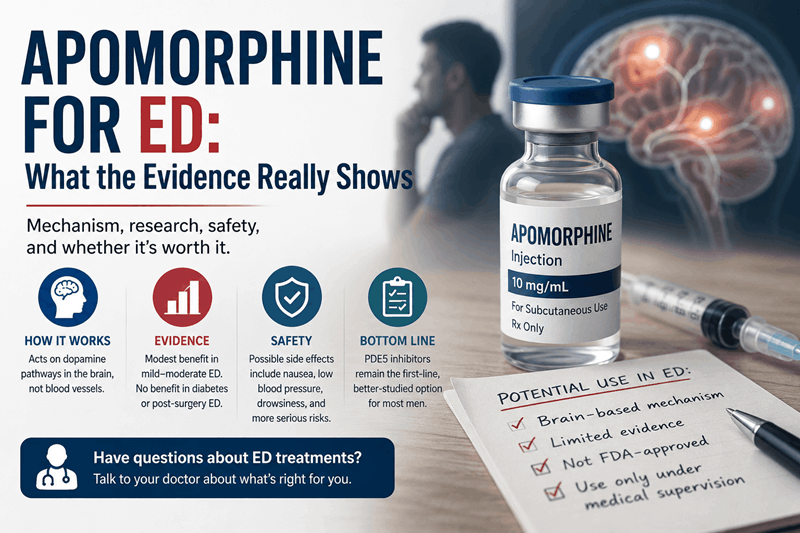
If you’ve searched around for erectile dysfunction (ED) treatments beyond the usual Viagra and Cialis, you may have come across apomorphine. It’s a real prescription medicine with a real mechanism — but it’s not approved for ED, and the evidence behind it is thinner than a lot of online write-ups suggest. Here’s a grounded look at what apomorphine is, how it’s supposed to work for ED, and whether it’s worth bringing up with your doctor.
Quick summary
- Apomorphine is FDA-approved for Parkinson’s disease, not ED.
- It works through the brain and nervous system, not on blood vessels directly — a fundamentally different mechanism than PDE5 inhibitors like sildenafil or tadalafil.
- Research on apomorphine for ED is limited to an oral/sublingual form that is no longer sold in the US; the injectable form (the one still available) hasn’t been studied for ED.
- Where evidence exists, it points to modest benefit in mild-to-moderate, more psychologically driven ED — and to no meaningful benefit over placebo in ED caused by diabetes or prostate surgery.
- Standard PDE5 inhibitors remain the first-line, better-studied option for most men.
What apomorphine actually is
Apomorphine is a dopamine agonist — a medicine that activates dopamine receptors in the brain rather than supplying dopamine itself. It’s used medically to manage motor symptoms of Parkinson’s disease, typically delivered as an injection under the skin (brand names include Apokyn and, more recently, Onapgo). An under-the-tongue tablet version existed for a time but was pulled from the US market in 2023 and is no longer available.
Despite the name recognition it has as a “sexual enhancement” ingredient in some corners of the internet, its FDA approval has only ever covered Parkinson’s — never ED.
Why it was ever considered for ED
Erections are usually a two-part process: a brain/nerve signal that arousal has started, and a vascular response in the penis that follows. Most ED medicines — Viagra, Cialis, Levitra, Stendra — target the second part. They’re PDE5 inhibitors, meaning they relax blood vessel walls so more blood can flow into the penis once arousal is already underway.
Apomorphine targets the first part instead. By stimulating dopamine receptors in areas of the brain tied to sexual arousal, it can help trigger the nerve signals that kick off an erection — without doing anything to the blood vessels themselves. That’s a meaningfully different mode of action, and it’s the reason researchers looked at apomorphine as a possible option for men whose ED seems to stem more from psychological or neurological factors than from a circulation problem.
Does it actually work?
The honest answer is: sometimes, modestly, and not for everyone.
A 2020 systematic review and meta-analysis pooling the available trials found that low-dose sublingual apomorphine (in the 2–3 mg range) could improve erectile function compared with placebo in some men — but the effect was concentrated in milder cases. In men whose ED was linked to diabetes or to prostate removal surgery, apomorphine performed no better than placebo.
A head-to-head study from 2008 compared sublingual apomorphine directly against sildenafil (Viagra) and found sildenafil produced better erections and better patient satisfaction. That comparison, combined with the overall weakness of the apomorphine data, is a big part of why apomorphine never became a mainstream ED treatment.
It’s also telling that apomorphine doesn’t appear in the American Urological Association’s ED treatment guidelines, and that the FDA rejected a new medicine application for apomorphine as an ED treatment back in 2003, citing insufficient efficacy and safety data. Sublingual apomorphine did go on to be marketed for ED in parts of Europe, but even there it never displaced PDE5 inhibitors as a first-choice option.
One more limitation worth flagging: nearly all of this research was done on the sublingual tablet, which no longer exists in the US market. The injectable form still sold today (for Parkinson’s) hasn’t been studied for ED at all, so there’s no real evidence base for using it that way.
Safety considerations
The safety data available comes from apomorphine’s use in Parkinson’s disease, at Parkinson’s-relevant doses — not from ED-specific use. Reported effects include:
- Yawning, drowsiness, nausea, and vomiting
- Runny nose and injection-site swelling
- Involuntary movements (dyskinesia)
More serious risks include a drop in blood pressure, fainting, confusion, rapid or irregular heartbeat, hallucinations, and — rarely — priapism (a prolonged, painful erection that needs emergency care).
Apomorphine also isn’t a safe combination with several common medicine classes, including blood pressure medications, other vasodilators, certain anti-nausea medicines like ondansetron, and other dopamine-blocking medications. Anyone with low blood pressure or cardiovascular disease would need a careful risk discussion with a prescriber before considering it.
Who might it make sense for — in theory
Setting aside its off-label status, the profile of a hypothetical candidate would be someone who:
- Hasn’t had success with, or can’t safely take, a PDE5 inhibitor (for example, due to nitrate use)
- Has mild-to-moderate rather than severe ED
- Has ED that seems driven more by stress, anxiety, or other psychological factors than by vascular disease
- Is not in an older age bracket where the medicine’s cardiovascular risks are more concerning, since it hasn’t been well studied in men over 65
Even within that group, this would be an off-label conversation to have with a physician, not a self-directed treatment choice — particularly since the form that was actually studied for ED isn’t available to prescribe in the US anymore.
What’s actually first-line for ED
For most men, PDE5 inhibitors remain the best-supported starting point:
- Sildenafil (generic Viagra)
- Tadalafil (generic Cialis)
- Vardenafil
- Avanafil
These work directly on penile blood flow, have decades of trial data behind them, and are the treatments named in professional ED guidelines. Alongside medication, addressing modifiable risk factors — regular exercise, better sleep, blood sugar and blood pressure control, and reducing chronic stress — has real evidence behind it for improving erectile function over time, and it helps regardless of which medication route someone chooses.
Frequently asked questions
Where can I buy apomorphine for ED?
Nowhere, legitimately — and that’s an important distinction, not a technicality. Apomorphine isn’t approved or manufactured for ED anywhere in the US. The sublingual tablet that was actually studied for ED (Uprima/Ixense) was discontinued years ago and isn’t sold in any market today. The only apomorphine products still made (Apokyn, Onapgo) are prescription-only injectables approved solely for Parkinson’s disease, dispensed through pharmacies with a Parkinson’s diagnosis and prescription.
Websites offering to sell apomorphine “for ED” without a prescription are not a safe or legal sourcing route — you’d have no assurance of what’s actually in the product, correct dosing, or purity, and apomorphine carries real cardiovascular risks (blood pressure drops, fainting) that make self-sourcing especially unwise. If you’re interested in an off-label option, the appropriate path is a conversation with a prescriber, not a purchase.
Does apomorphine have good reviews for ED?
There isn’t a meaningful body of consumer reviews to point to, because apomorphine isn’t sold or marketed for ED anywhere it’s currently available. What exists instead is clinical trial data (discussed above), which showed modest benefit in milder cases and no benefit over placebo in diabetes-related or post-surgical ED. Treat any “reviews” you find online with skepticism — they’re likely referring to a discontinued product, a different medicine entirely, or unverified sourcing.
How much does apomorphine cost?
There’s no price to quote for “apomorphine for ED” since no such product exists on the market. For context, the Parkinson’s-approved injectable (Apokyn) is a specialty medicine — historically priced in the hundreds of dollars per month range depending on dose and insurance coverage, and typically requiring prior authorization. That pricing has no bearing on ED use, since insurers won’t cover a Parkinson’s medicine for an unapproved indication.
Is there an over-the-counter alternative to apomorphine for ED?
Not one with comparable evidence. There’s no OTC medicine that replicates apomorphine’s dopamine-based mechanism. If the appeal is avoiding a prescription medicine requirement, the realistic OTC-adjacent options are supplements like L-arginine or L-citrulline, which have some limited evidence for modestly improving blood flow, but nowhere near the strength of evidence behind prescription PDE5 inhibitors — and supplements aren’t FDA-regulated for efficacy the way medicines are. For most men, a low-dose generic PDE5 inhibitor (sildenafil or tadalafil) prescribed after a telehealth or in-person visit is a more evidence-backed and only modestly less convenient option than a true OTC product.
Bottom line
Apomorphine is a legitimate medicine with a genuine, if limited, evidence trail in ED — but it’s not FDA-approved for that use, the version that was studied isn’t sold in the US anymore, and where it did help, it helped modestly and in a narrower group of men than PDE5 inhibitors do. If standard ED treatments haven’t worked for you or aren’t an option due to a health condition, that’s worth raising directly with a healthcare provider — apomorphine might come up as one of several off-label or alternative paths, but it won’t be the first one offered, and for good reason.
This article is for informational purposes only and isn’t a substitute for personalized medical advice. Talk to a healthcare provider about diagnosis and treatment options for erectile dysfunction.