

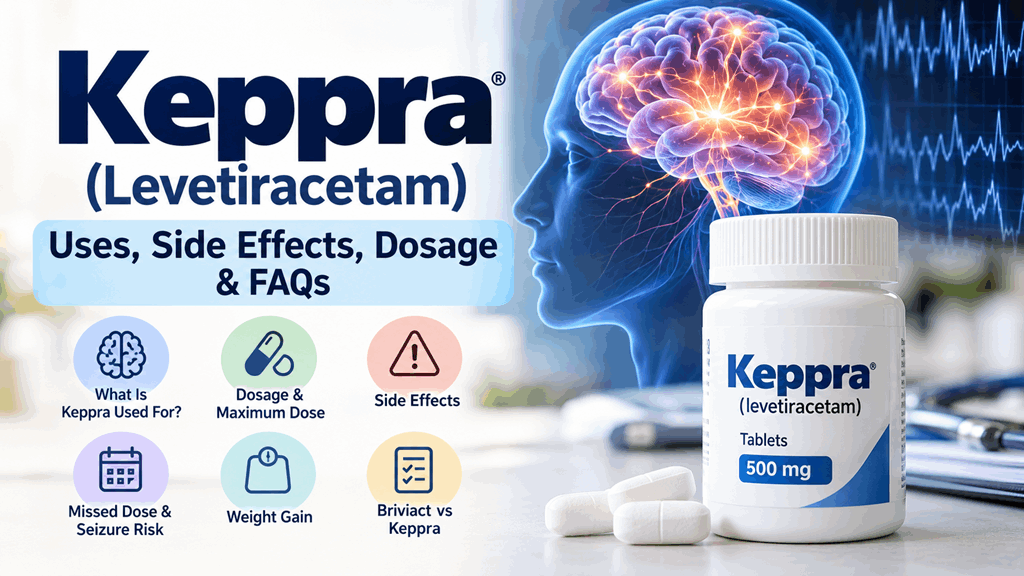
- What Is Keppra?
- What Is Keppra Used For?
- What Is the Generic Name for Keppra?
- Keppra Side Effects: Common and Serious Reactions
- Maximum Dose of Keppra for Adults
- How Long Does It Take for Keppra to Work?
- Chances of Having a Seizure on Keppra
- Can Missing One Dose of Keppra Cause a Seizure?
- Can Keppra Be Crushed?
- Does Keppra Cause Weight Gain?
- Briviact vs Keppra: What's the Difference?
- Important Precautions Before Taking Keppra
- Frequently Asked Questions About Keppra
- 1. What is Keppra used for?
- 2. What is the generic name for Keppra?
- 3. What are the most common Keppra side effects?
- 4. What is the maximum dose of Keppra for adults?
- 5. Is 3,000 mg of Keppra a high dose?
- 6. Can missing one dose of Keppra cause a seizure?
- 7. How long does it take for Keppra to work?
- 8. Does Keppra cause weight gain?
- 9. Can Keppra be crushed?
- 10. What are the chances of having a seizure on Keppra?
- 11. What is the difference between Briviact and Keppra?
- 12. Does Keppra make you sleepy?
- 13. Can you stop taking Keppra suddenly?
- 14. Can you drink alcohol while taking Keppra?
- 15. Can Keppra affect your mood?
- 16. Is Keppra safe for long-term use?
- Final Thoughts
- Medical References
Keppra is a prescription anti-seizure medication commonly used to manage epilepsy and reduce the frequency of seizures. Its active ingredient, levetiracetam, helps regulate abnormal electrical activity in the brain that can trigger seizures.
People prescribed Keppra often have questions about its effectiveness, possible side effects, recommended dosage, and whether seizures can still occur during treatment. Others want to understand how Keppra compares with newer medications such as Briviact.
This comprehensive guide explains what Keppra is used for, how it works, its generic name, potential side effects, maximum recommended adult dosage, and important precautions.
Medical disclaimer: This article is for educational purposes only and does not replace professional medical advice. Never change, stop, or skip prescribed anti-seizure medication without consulting your healthcare professional.
What Is Keppra?
Keppra is the brand name for levetiracetam, an anticonvulsant medication used to treat certain types of epileptic seizures.
It belongs to a group of medicines called anti-seizure medications (ASMs), which help reduce abnormal electrical signaling in the brain.
Keppra is available in several formulations, including immediate-release tablets, oral solution, and intravenous injection. Extended-release levetiracetam is also available under separate product labeling.
Unlike some older anti-seizure medications, levetiracetam has relatively few clinically significant drug interactions. However, it can cause behavioral changes, dizziness, fatigue, and other adverse effects.
What Is Keppra Used For?
Keppra is primarily prescribed to treat epilepsy and prevent certain types of seizures.
Its FDA-approved uses include:
- Partial-onset seizures: Seizures that begin in one area of the brain.
- Myoclonic seizures: Brief, sudden muscle jerks associated with juvenile myoclonic epilepsy.
- Primary generalized tonic-clonic seizures: Seizures involving widespread brain activity that may cause loss of consciousness, muscle stiffness, and rhythmic jerking.
Keppra may be prescribed alone for certain partial-onset seizures or alongside other anti-seizure medicines, depending on the patient’s diagnosis, age, and formulation.
How Does Keppra Work?
Levetiracetam binds to a protein in the brain called synaptic vesicle protein 2A (SV2A).
This interaction helps regulate neurotransmitter release and reduces abnormal neuronal activity associated with seizures.
Although the complete mechanism is not fully understood, its effect on SV2A is considered central to its anti-seizure action.
What Is the Generic Name for Keppra?
The generic name for Keppra is levetiracetam.
Generic levetiracetam contains the same active ingredient as brand-name Keppra and must meet applicable regulatory standards for quality and bioequivalence.
| Feature | Keppra | Generic levetiracetam |
|---|---|---|
| Active ingredient | Levetiracetam | Levetiracetam |
| Drug category | Anticonvulsant | Anticonvulsant |
| Primary use | Epilepsy and seizure control | Epilepsy and seizure control |
| Effectiveness | Established | Expected to be equivalent when approved |
| Cost | Often higher | Generally lower |
| Prescription required | Yes | Yes |
Patients should confirm that their generic prescription has the correct strength and release formulation. Anyone experiencing changes in seizure control after switching products should consult their clinician.
Keppra Side Effects: Common and Serious Reactions
Like all prescription medicines, Keppra may cause side effects. Some are mild and improve as the body adjusts, while others require prompt medical attention.
Common Keppra side effects
- Sleepiness: Drowsiness or reduced alertness, particularly when starting treatment.
- Dizziness: Lightheadedness or balance difficulties.
- Fatigue: Unusual tiredness or weakness.
- Irritability: Increased frustration, agitation, or emotional sensitivity.
- Headache: Some patients report headaches during treatment.
- Behavioral changes: Mood swings, anger, or aggression may occur.
These reactions vary between individuals. Not everyone taking Keppra experiences them.
Serious Keppra side effects
Some adverse reactions require immediate evaluation, including:
- New or worsening depression or suicidal thoughts.
- Severe aggression, hallucinations, or unusual behavior.
- Serious allergic reactions involving facial swelling or difficulty breathing.
- Severe skin reactions, particularly rash accompanied by fever, blistering, or peeling.
- Severe coordination problems or significant difficulty walking.
Keppra can also cause rare but serious reactions such as DRESS, a potentially life-threatening drug hypersensitivity syndrome.
Seek emergency medical care for breathing difficulty, severe allergic symptoms, or a severe blistering rash. Seek urgent help for suicidal thoughts or dangerous behavioral changes.
Important: Do not suddenly discontinue Keppra because of side effects. Abrupt withdrawal can increase seizure frequency and may trigger status epilepticus.
Maximum Dose of Keppra for Adults
The maximum recommended daily dose of immediate-release Keppra for most adults with normal kidney function is 3,000 mg per day, generally divided into two doses of 1,500 mg.
The exact dose depends on the seizure type, kidney function, treatment response, and tolerability.
Typical adult Keppra dosage
| Treatment stage | Common immediate-release dose |
|---|---|
| Starting dose | 500 mg twice daily |
| First possible increase | 1,000 mg twice daily |
| Maximum recommended dose | 1,500 mg twice daily |
| Maximum total daily dose | 3,000 mg |
Dose increases are commonly made at intervals of approximately two weeks when clinically appropriate.
Patients with impaired kidney function may require substantially lower doses because levetiracetam is primarily eliminated through the kidneys.
The above schedule is general prescribing information, not a recommendation to increase medication without medical supervision.
Is 3,000 mg of Keppra a High Dose?
Yes. A total of 3,000 mg daily is considered a high dose because it is the maximum recommended daily dose for most adults with normal renal function.
However, it is not automatically an overdose when prescribed appropriately.
A neurologist may prescribe this amount when lower doses do not provide sufficient seizure control.
Doses above 3,000 mg daily have been studied, but there is insufficient evidence that higher doses provide additional benefit.
Patients should never increase their prescribed dose independently.
How Long Does It Take for Keppra to Work?
Keppra begins entering the bloodstream relatively quickly after oral administration. Immediate-release levetiracetam generally reaches peak blood concentrations approximately one hour after a dose in fasting adults.
However, reaching a therapeutic blood concentration is not the same as achieving reliable seizure control.
The time needed to evaluate Keppra’s effectiveness depends on several factors:
- The type and frequency of seizures.
- The starting dose and subsequent adjustments.
- Whether other anti-seizure medicines are being used.
- Individual response and kidney function.
- How consistently the medication is taken.
Steady-state concentrations are generally achieved within about two days of twice-daily administration in adults with normal renal function.
Nevertheless, determining whether Keppra adequately controls seizures may require several weeks or longer, particularly when seizures occur infrequently.
Chances of Having a Seizure on Keppra
Although Keppra can significantly reduce seizure frequency, it does not guarantee that every patient will become seizure-free.
The chances of having a seizure while taking Keppra depend on the underlying epilepsy syndrome, seizure history, prescribed dose, treatment adherence, and individual response.
Why can seizures still happen while taking Keppra?
Breakthrough seizures may occur because of:
- Missed or delayed medication doses.
- Insufficient seizure control at the current prescribed dose.
- Sleep deprivation or significant sleep disruption.
- Illness or fever.
- Alcohol use or withdrawal.
- Individual epilepsy-related factors.
There is no single reliable percentage representing the likelihood of seizures for every patient taking Keppra.
Clinical studies demonstrate that levetiracetam reduces seizure frequency in many patients, but outcomes differ by population and seizure type.
Anyone experiencing breakthrough seizures should contact their neurologist for a treatment review.
Keeping a seizure diary can help identify patterns, possible triggers, and changes in seizure frequency.
Can Missing One Dose of Keppra Cause a Seizure?
Yes. Missing even one dose of Keppra can increase the risk of a breakthrough seizure, although it does not mean a seizure will definitely occur.
Maintaining consistent medication levels is important for seizure prevention.
What should you do if you miss a dose?
For commonly prescribed twice-daily immediate-release levetiracetam, general guidance is to take a missed dose when remembered unless it is nearly time for the next scheduled dose.
If the next dose is approaching, skip the missed dose and continue the regular schedule.
Never take two doses together to compensate for a missed dose.
Because instructions may vary by formulation and circumstances, follow your pharmacist’s or prescriber’s advice.
If several doses have been missed, or a seizure occurs, seek medical guidance.
Can Keppra Be Crushed?
No. According to the FDA-approved prescribing information, Keppra tablets should be swallowed whole and should not be chewed or crushed.
This is particularly important for extended-release formulations such as Keppra XR, which are designed to release medication gradually.
Crushing extended-release tablets can interfere with their intended release characteristics.
What if you cannot swallow Keppra tablets?
Patients who have difficulty swallowing tablets should ask their healthcare professional about alternative formulations.
Keppra is available as an oral solution, which may be suitable for patients who cannot swallow conventional tablets.
Do not crush or alter tablets without confirmation from a pharmacist or prescriber.
Does Keppra Cause Weight Gain?
Weight gain is not generally considered one of the most common side effects of Keppra.
Levetiracetam is often regarded as relatively weight-neutral compared with certain other anti-seizure medications.
However, some patients may notice weight changes during treatment.
Potential contributing factors include changes in appetite, activity levels, other medications, and underlying health conditions.
Can Keppra cause weight loss?
Weight loss may also occur in some patients, although it is not a predictable or intended treatment effect.
Unexplained or persistent changes in weight should be discussed with a healthcare professional rather than automatically attributed to Keppra.
Briviact vs Keppra: What’s the Difference?
Comparison of brivaracetam and levetiracetam
Briviact (brivaracetam) and Keppra (levetiracetam) are prescription anti-seizure medications that act on synaptic vesicle protein 2A (SV2A).
Although they share a related mechanism of action, they are different medicines and are not interchangeable milligram for milligram.
| Feature | Keppra | Briviact |
|---|---|---|
| Generic name | Levetiracetam | Brivaracetam |
| Mechanism | SV2A binding | SV2A binding |
| FDA-approved seizure indication | Partial-onset, plus adjunctive treatment for certain generalized seizures | Partial-onset seizures |
| Typical adult starting dose | 500 mg twice daily | 50 mg twice daily |
| Maximum recommended adult daily dose | 3,000 mg | 200 mg |
| Common side effects | Sleepiness, dizziness, fatigue, behavioral changes | Sleepiness, dizziness, fatigue, nausea |
| US controlled substance status | Not scheduled | Schedule V |
Is Briviact better than Keppra?
Neither medicine is universally better.
Briviact has a higher binding affinity for SV2A and may be considered when patients experience inadequate seizure control or troublesome adverse effects with another treatment.
Some patients who experience irritability or behavioral symptoms with levetiracetam may tolerate brivaracetam better. However, evidence does not establish that Briviact is consistently more effective or better tolerated for every patient.
Briviact also has different prescribing considerations, including its controlled-substance classification in the United States.
Switching from Keppra to Briviact should be supervised by a neurologist, who can determine an appropriate transition plan and monitor seizure control.
Important Precautions Before Taking Keppra
Patients should inform their healthcare professional about their medical history and other medicines before beginning Keppra.
Kidney problems
Because levetiracetam is primarily cleared by the kidneys, reduced kidney function can increase drug exposure. Dose adjustments may be necessary.
Mental health and behavioral changes
Keppra can cause irritability, aggression, depression, and other psychiatric symptoms. Patients and caregivers should monitor for unusual behavioral changes.
Pregnancy and breastfeeding
Patients who are pregnant, planning pregnancy, or breastfeeding should discuss treatment with their neurologist and obstetric clinician.
Uncontrolled seizures can pose serious risks, and stopping treatment without medical supervision can be dangerous. Medication levels and dosing may require review during pregnancy.
Driving and operating machinery
Keppra may cause dizziness, sleepiness, and coordination difficulties.
Patients should avoid driving or operating dangerous machinery until they understand how the medicine affects them and meet applicable seizure-related driving requirements.
Frequently Asked Questions About Keppra
1. What is Keppra used for?
Keppra is an anti-seizure medicine used to treat partial-onset seizures and, as adjunctive therapy, certain myoclonic and generalized tonic-clonic seizures.
2. What is the generic name for Keppra?
The generic name for Keppra is levetiracetam, a prescription anticonvulsant medication.
3. What are the most common Keppra side effects?
Common side effects include sleepiness, dizziness, fatigue, weakness, and irritability. Behavioral changes can also occur.
4. What is the maximum dose of Keppra for adults?
The maximum recommended dose for most adults with normal kidney function is 3,000 mg daily, usually taken as 1,500 mg twice daily.
5. Is 3,000 mg of Keppra a high dose?
Yes. A daily dose of 3,000 mg is the usual maximum recommended adult dose and should only be taken when prescribed.
6. Can missing one dose of Keppra cause a seizure?
Yes. Missing a dose may increase the risk of a breakthrough seizure, although a seizure is not inevitable.
7. How long does it take for Keppra to work?
Keppra is absorbed quickly, but assessing its effectiveness for seizure prevention may take weeks or longer.
8. Does Keppra cause weight gain?
Weight gain is not a common or predictable Keppra side effect, although individual patients may experience weight changes.
9. Can Keppra be crushed?
No. Keppra tablets should be swallowed whole. Ask a pharmacist about oral solution if swallowing tablets is difficult.
10. What are the chances of having a seizure on Keppra?
The risk varies depending on epilepsy type, medication adherence, treatment response, and other factors. Breakthrough seizures remain possible.
11. What is the difference between Briviact and Keppra?
Briviact contains brivaracetam, while Keppra contains levetiracetam. Both target SV2A but differ in dosing, approved indications, and tolerability.
12. Does Keppra make you sleepy?
Yes. Sleepiness is a common side effect, particularly when treatment begins or the dose is increased.
13. Can you stop taking Keppra suddenly?
No. Abrupt discontinuation may cause increased seizure frequency or status epilepticus. A clinician should supervise withdrawal.
14. Can you drink alcohol while taking Keppra?
Alcohol can worsen drowsiness and may increase seizure risk in some individuals. Discuss alcohol use with your healthcare professional.
15. Can Keppra affect your mood?
Yes. Keppra can cause irritability, agitation, aggression, and mood changes. Significant changes should be reported promptly.
16. Is Keppra safe for long-term use?
Keppra is frequently prescribed for long-term epilepsy management. Continued monitoring is important to evaluate effectiveness, side effects, and kidney function.
Final Thoughts
Keppra (levetiracetam) is a widely prescribed medication for managing epilepsy and preventing seizures. Its relatively limited drug-interaction profile makes it an important treatment option for many patients.
However, understanding Keppra side effects, taking doses consistently, and following the prescribed treatment schedule are essential for safe and effective seizure management.
The maximum recommended adult dose is generally 3,000 mg per day, although patients with kidney problems may require lower doses.
While some people achieve excellent seizure control with Keppra, others may experience breakthrough seizures or side effects requiring treatment adjustments.
Patients should work closely with their healthcare professional to determine the most appropriate long-term treatment strategy.
Medical References
This article draws on official prescribing information and patient guidance: